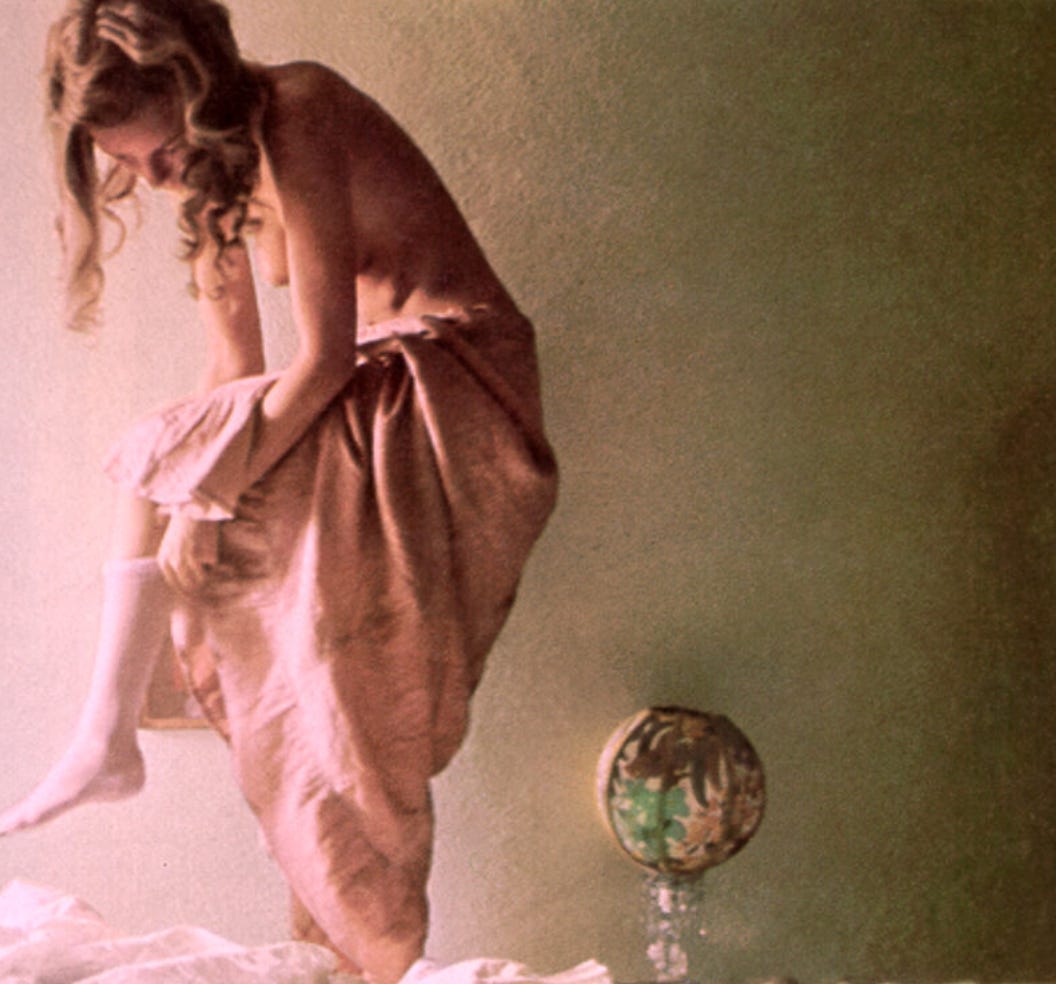
If I Should Have a Daughter
If I should have a daughter, I am going to name her something soft that people will mispronounce the first time and remember the second. Because that’s her first lesson: the world will not get you right on the first try. Give it another.
I will teach her to fold things. Not because folding is a woman’s work, but because there is a kind of thinking that only happens when your hands are busy, the way my grandmother used to fold money into envelopes, labeled in handwriting no one else could read, as if the future were a language only she was fluent in.
I will tell her: your great-grandmother built things. Not with venture capital or a business plan or a room full of people who believed in her. With repetition. With showing up on days that did not show up for her. And when what she built eventually came apart because things do, baby, things come apart, she did not sit in the rubble and call it failure. She just started folding again.
Remember that.
There will be a morning when she comes to me with something broken. A friendship. A promise. A version of herself she thought was permanent. And I will not say everything happens for a reason because that is a sentence people say when they don’t want to sit with you in the mess.
I will sit with her in the mess.
I will say: I know. I know it doesn’t make sense yet. It won’t for a while. And that’s okay. You are not behind. You are just in the middle.
And baby, the middle is where most of life actually happens.
I am going to teach her about money. Early. Not in the way the world teaches girls about money as an afterthought, as something someone else will handle, but the way my mother taught me, accidentally, the night her second marriage ended, and I watched her sit at the kitchen table with a calculator and a silence so loud it rearranged my childhood.
I will tell her: always know the math. Not because love isn’t enough, but because I have watched women love so hard they forgot to count what was left. And I don’t want her to ever sit at a table like that, surprised.
I want her to sit at tables prepared.
I would teach her to stop romanticizing the struggle.
I know. That’s strange, coming from me. A woman who built everything from the math at the kitchen table. But that’s exactly why I’d say it. Because I know how seductive it becomes… the identity of the one who survived. The girl who figured it out. The woman who didn’t need anyone. You wear it so long it starts to feel like skin. And then someone tries to help you carry something, and you flinch. Not because you don’t want help. But because you forgot that help doesn’t always come with a cost.
I’d tell her: let people carry things for you sometimes. Not because you can’t. Because you can, and choosing not to is a different kind of strength. One that took me longer to learn than the bar exam.
I would tell her that beauty is not currency.
That people will treat it like it is, and that beauty is going to be a strange door. People will open it for her and then resent her for walking through. They will assume she has not earned the things she carries. And that is a strange grief, to earn something and still wonder if it was given.
You come from women who were not given instructions.
So when they hand you a version of the world that feels too small for you, too simple, too neat, too sure of what a girl like you is supposed to become, I want you to be polite about it.
And then build something bigger.
I’d tell her: You will spend a portion of your life proving that you are more than the first thing people notice. That is unfair. It is also not going to change. So do the work anyway, and let the work speak, and do not shrink yourself to make your intelligence less threatening to people who expected you to be simple.
And when that happens, and baby, it will happen more times than I can prepare her for, I will tell her what my grandmother never said out loud but taught me anyway:
You do not owe anyone your explanation. You do not have to unfold your history on every table just to be believed. Some people will choose the wrong version of you, and that is not your project to fix.
But.
Don’t let that make you hard.
That’s the tricky part. That’s the part no one warns you about. That the same walls that protect you can also lock you in. That the same silence that keeps you dignified can also keep you lonely. That you can get so good at not needing anyone that you forget how to let someone in, and then one day you’re standing in a kitchen, fully capable, completely independent, wondering why the room still feels like it’s missing a chair.
So I will teach her to be soft where it matters.
To let people mispronounce her and still offer her name again. To know the math, but also know when to stop counting. To fold things and also to let things be unfolded.
I am going to tell her about the curfew. About how I got my first job at fourteen, not because I was ambitious, but because I wanted to leave the house, and how that accident became the architecture of everything I built after. I will tell her: sometimes the best things you build start as an excuse to get out the door.
She is going to watch me work too much. I already know this. She is going to say mama, you’re always busy and I am going to feel it in a place I didn’t know I had until she existed. And I will put the phone face down. And I will sit on the floor with her and apologize.
I will tell her: You will fall in love with someone who does not understand the weight you carry. That is not their fault. Most people have not had to calculate what’s left. Most people were not aware of the structure when it disappeared. And that’s okay because that is actually the kind of life I worked to give you.
And when someone loves you, because they will, baby, people will love you in all kinds of imperfect, inconvenient, badly timed ways, don’t ask them to prove it every day. Don’t test them with silence. Don’t make them solve you. That’s something your mother did for a long time, and I’m telling you now so you can skip that chapter.
Let people love you in the middle. Not when you’re polished. Not when the apartment is clean, and the plan is working, and you’ve got the answer to every question. Let them see the Tuesday version. The messy draft. The girl who still calls her grandmother’s phone number sometimes just to hear it ring.
And one day, she is going to love someone with every fire she has.
The kind of love that rearranges furniture in her chest. The kind that makes her forget she was ever careful. She will call me from a parking lot or a bathroom floor or a kitchen that smells like his cologne, and she will say, “Mama, I’ve never felt anything like this”, and I will believe her. Because I remember.
I will not tell her to be careful. She won’t hear me anyway.
What I will tell her, later, when the fire has done what fire does, is this: Sometimes the person who teaches you how much you can feel is not the person you build a life with. And that is not a failure. That is not wasted love. That is the one who shows you the size of your own heart so that when the right one comes, the one who is less fire and more shelter, less earthquake and more ground, you’ll know how much room you have to offer.
She will not believe me at first. She will think I don’t understand. She will think her love is the exception, the one that survives the burning. And maybe it will be. But if it isn’t, if she calls me one night and her voice is the kind of quiet that means everything just ended, I won’t say I told you so. I won’t say there are other people. I will say: I know. Come home.
And when she’s ready, I’ll tell her what no one told me: that the love that wrecks you and the love that keeps you are rarely the same person. And the grief of learning that is one of the most adult things she’ll ever do.
And after all of that, I think the biggest piece of wisdom, if I even have a daughter, is this:
You do not have to earn the right to be happy.
You don’t have to survive something first. You don’t have to show receipts. You don’t have to justify your peace by listing everything that came before it. You are allowed to just be in the room, without a story, without proof, without the calculator running in the back of your mind.
You are allowed to just be in the room.


🤍
So…it’s not that my daughter’s name is hard to pronounce. But I picked it because it’s uncommon and more memorable.
Regardless, I love the comments and thoughts in this piece.