Working Art
My best friend once said that I could empathize with a chair if I wanted to
I didn’t realize I was learning a new language at first. I thought I was just looking at furniture.
It started practically— curiosity about materials, about why certain pieces felt inevitable in a room while others felt loud or temporary. Then it widened. I learned that many of the objects we now call “classics” aren’t frozen in time at all, but actively stewarded. Companies like Herman Miller and Vitra still manufacture designs by Charles Eames and Ray Eames, not as nostalgia, but as continuity. Cassina does the same through licensed re-editions, not reproductions, but authorized extensions of an idea that was always meant to last.
That distinction mattered more than I expected. Replica versus original wasn’t about status. It was about lineage. About knowing that a piece wasn’t just copied in form, but carried forward with its intentions intact.
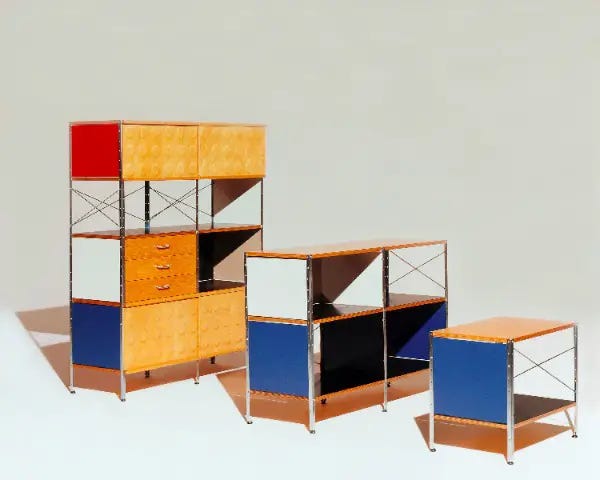
The Eames Storage Unit made that click for me. Designed between 1949 and 1950, it emerged from a post-war urgency: housing was changing, lives were becoming more modular, and furniture needed to keep up. Charles and Ray Eames applied industrial manufacturing principles such as steel frames, birch plywood, Masonite panels not to strip away warmth, but to make adaptability affordable. The unit could be assembled, disassembled, reconfigured. Nothing was hidden. The structure was the design.
What struck me wasn’t just how modern it still looks, but how playful it is without being unserious. The colored side panels, the asymmetry, the one-off drawers— it almost feels like Lego if Lego had been designed by architects. It borrows from Bauhaus discipline which draws honesty of material, visible structure, geometry as function yet softens it with something human. Not decoration, but function. You’re allowed to change it. You’re allowed to live with it imperfectly.
That realization reframed how I looked at other pieces. The Kartell 4602 chest, designed in the 1970s by Simon Fussell, carries a similar spirit in a different register. It’s often described as whimsical, but that word undersells it. The drawers stack. They rotate. The chest refuses a single orientation. It’s storage that acknowledges movement of homes, of lives, of taste. Plastic here isn’t cheapness but a belief that good design should be light enough to rearrange, democratic enough to touch, clever enough to surprise.
I realized then that these objects weren’t meant to be collected like paintings or shown off like bags and jewelry. They were meant to be used. To be opened. To be leaned against. Their beauty isn’t diminished by fingerprints; it’s completed by them.
That’s also where my feelings about originals crystallized. I deeply appreciate replicas especially ones done well of USM. They make design accessible, and access matters. But there is something else in originals or in authorized editions that’s difficult to name without sounding pretentious, so I’ll try to say it plainly: they hold time differently. Either they’ve been kept pristine through decades, cared for by someone who understood their value early, or they’ve been refurbished because the materials were made to endure. Stainless steel that can be refinished. Wood that can be sanded and oiled again. Hardware designed to be tightened, not replaced.
Certain aluminum and steel pieces may look very doable conceptually, but the difficulty jumps sharply depending on material fidelity and finish expectations. The piece you’re showing looks simple, but it’s deceptively demanding.
That sentence kept proving itself true. Stainless steel furniture isn’t expensive because it’s trendy. It’s expensive because flatness is unforgiving, welds distort, grain direction exposes mistakes, and edges have to be finished by hands that understand restraint. You’re not paying for your home to look good. You’re paying for someone else’s precision— for an idea executed so carefully that it disappears into calm.
This is where design starts to feel emotional to me. Not sentimental, but symbolic. A chair that looks like a single line that I quietly fixated on for months: the so-called “Z” form, so deceptively straightforward but is actually a negotiation between gravity, comfort, and load. A shelf that feels quiet has likely fought dozens of small battles in its making. Utility becomes expression precisely because it has constraints.
The principles I kept running into read almost like ethics:
honesty of material
visible structure
geometry as function
no decoration
Yet many contemporary pieces push further, into sculptural mass, plate geometry, gallery presentation. I don’t see that as a contradiction. It’s a conversation. Bauhaus asked design to be truthful; later movements asked it to be felt.
That sensitivity extends into space itself. Horizontal and vertical spacing aren’t aesthetic afterthoughts as I learned after hours of redrawing the layout of the walls I had in my bedroom to work with— they govern how a room breathes. I also learned that mirrors don’t automatically expand a space; if placed poorly, they divide it. Placed well, they extend sightlines, borrow light, create continuity. There’s something quietly instructive in that. Not every reflection helps you see more.
Somehow, through all of this, I realized I wasn’t just learning about furniture. I was learning about another facet of art… one that most people dismiss as utility because it doesn’t hang on a wall. But that’s precisely the beauty of it. This art has to be touched. It has to work. It has to age alongside you.
And, as my coach has taught me to do, I paused long enough to ask why. Why I’m drawn to geometry, to proportion, to how objects resolve themselves down to the material used. The more I sat with it, the clearer it became: I’m less interested in things that announce themselves loudly than in things that hold together. I’m drawn to work that explains itself through use, that earns confidence quietly, and that doesn’t collapse under hardship, repetition or time.
And maybe that’s why it resonates so deeply with me. These pieces don’t ask to be admired. They ask to be lived with.


wow interior design is one thing i know virtually nothing about but somehow i liked this a lot
You would love some of the stuff my mom has picked out and refurbished over the years. Very similar era/style, but I don't know much on the subject. I just really don't like particle board... The points of fastening/attachment eventually turn into points of weakness over time when they should be the opposite. I find it so satisfying when you can actually tighten the hardware on a peice of furniture because it's made of something robust like solid wood or steel. It doesn't start squishing, bending, or cracking when you move or fasten it...